
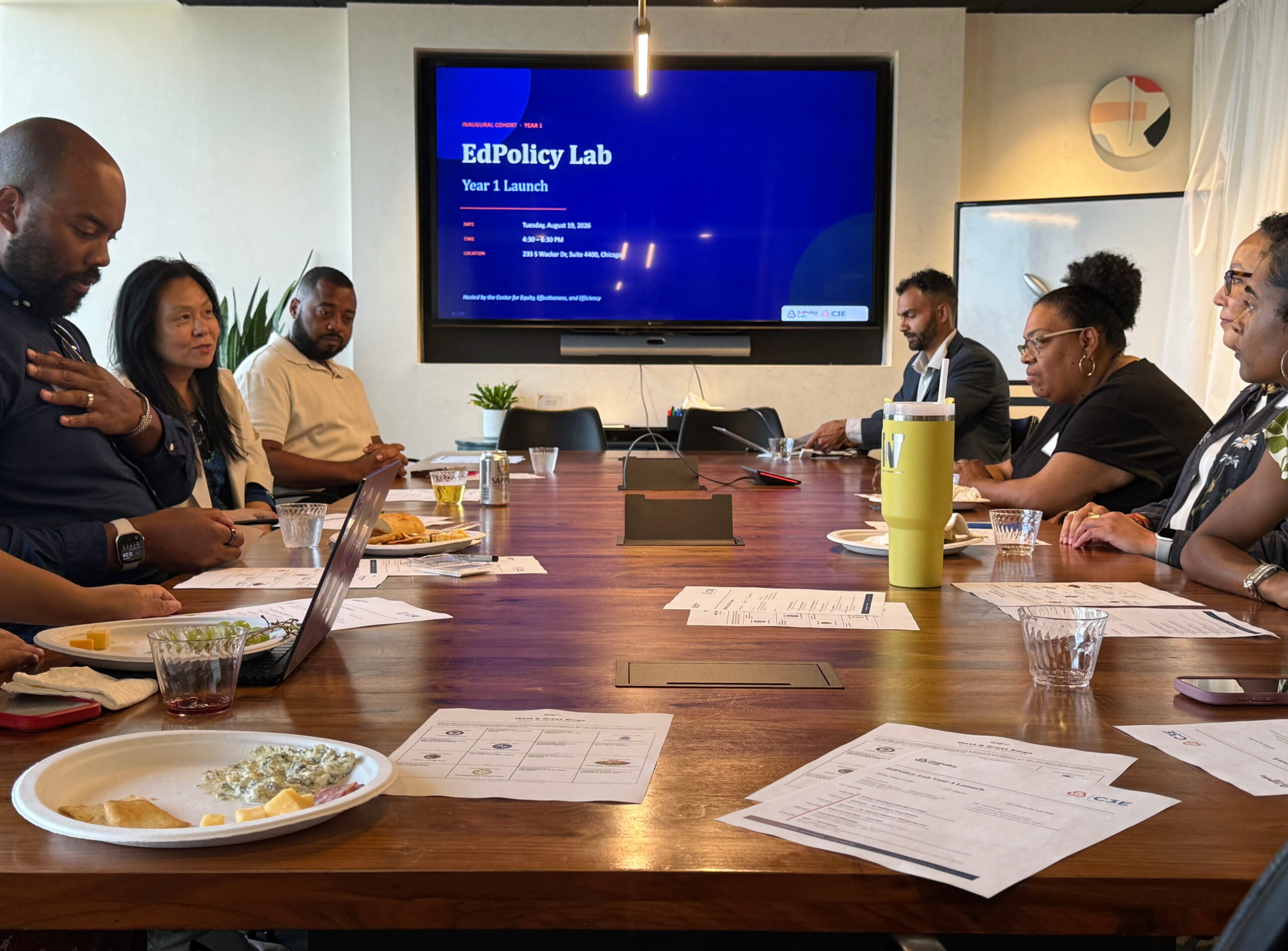
The EdPolicy Lab (EPL) is a three-year, cohort-based school equity fellowship supporting six Chicago Public Schools (CPS) schools. It equips school leadership teams and staff to embed racial equity, targeted universalism, and cultural responsiveness directly into school governance.
The SY2027-2029 cohort applications are now closed.
Meet the EPL SY2027 Cohort
Six Chicago Public Schools. Different neighborhoods. A shared commitment to equity.
Geographic & Racial Diversity
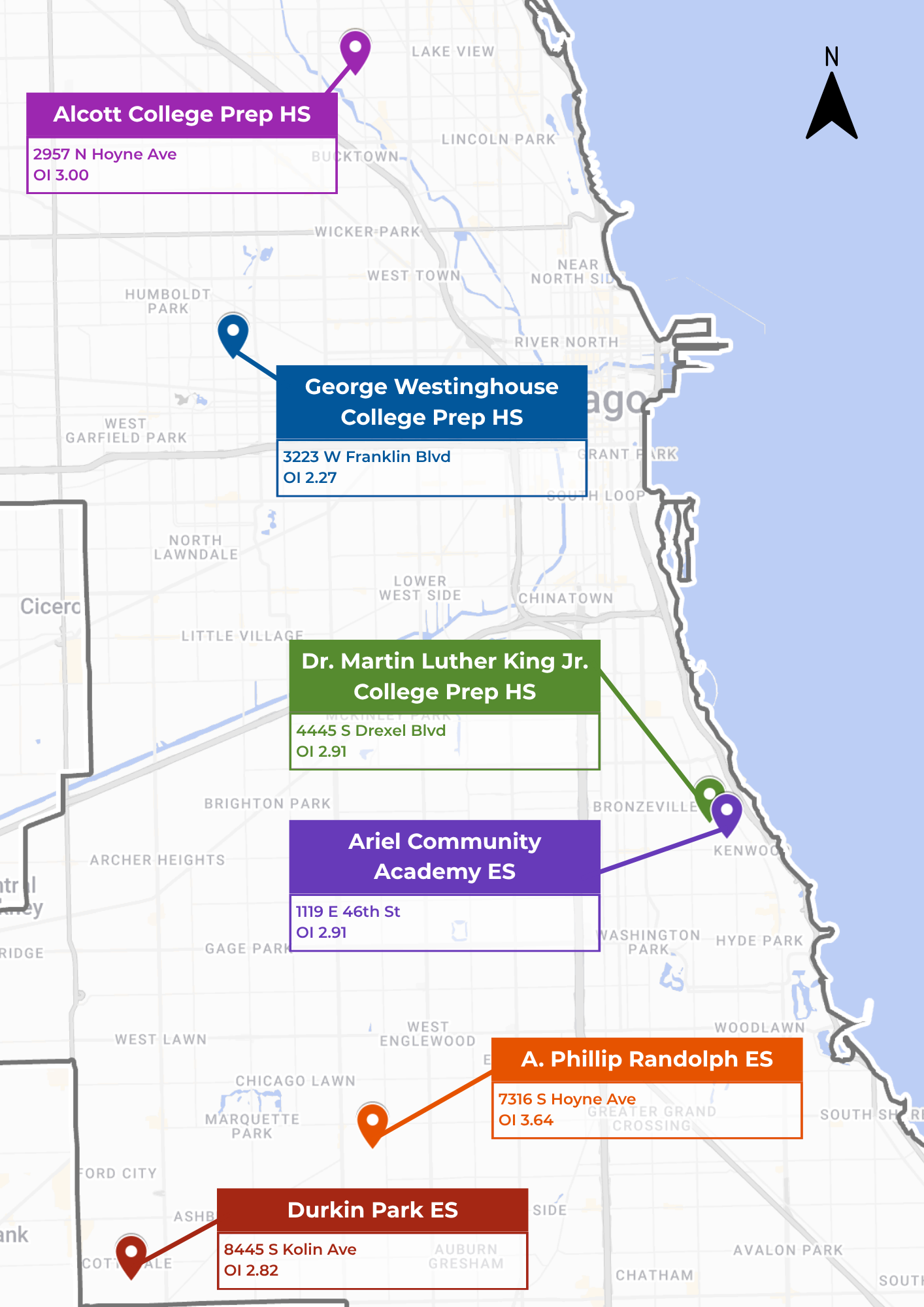
EdPolicy Lab spans Chicago’s geographic and racial spectrum. Our schools range from predominantly Black and Latino communities on the South and West Sides to more affluent, majority-White North Side neighborhoods. Student populations reflect that range—from 98% Black at Ariel to 67% Latinx at Alcott, with more mixed populations at schools like Westinghouse.
Opportunity & Need
Our schools span a wide range of CPS Opportunity Index levels, allowing EdPolicy Lab to work across communities with very different contexts and levels of need—from A. Phillip Randolph ES (OI 3.64) to Westinghouse HS (OI 2.27).
Diversity & Leadership Buy-In
10
Black, Latinx & White leaders across our inaugural cohort’s principals, APs & instructional leaders
6
Principals participate in the monthly cross-school EdPolicy Lab leadership PLC
4
Schools include an
AP alongside their
principal in the
monthly PLC
“For any school that’s committed to making meaningful systemic progress across equity, this work is transformative… grounded in genuine community partnership, which is essential for schools ready to move beyond the traditional rhetoric into real lasting change.”
–– Diamond Bogard, Assistant Principal of Westinghouse College Prep
Curriculum
EPL is grounded in two frameworks – Reimagining Equity through Dynamic Inquiry (REDI) and Community Co-design for Equity in School Districts – that are directly connected to the implementation of the Chicago Public Schools Equity Framework. Together, these frameworks support the operationalization of equity in practice by translating district-level commitments into school-based systems for continuous improvement, shared decision-making, and culturally responsive leadership.
Reimagining Equity through Dynamic Inquiry (REDI)
Community Co-Design for Equity
Our signature REDI framework is a field-tested, three-year organizational transformation model and competency-attainment framework for school leadership development. Under the REDI model, a dedicated cohort of staff applies continuous improvement (PDSA cycles) across four core organizational domains to embed equity into daily school routines:
- Policy Analysis: Analyzing who benefits and who is burdened by existing school rules.
- Process Change: Shifting administrative workflows from top-down mandates to collaborative decision-making.
- Project Management: Building systematic implementation plans to execute co-designed solutions with high fidelity.
- Emotional Intelligence: Navigating the discomfort, relational conflict, and personal reflection required to lead racial equity work.
Teams co-create one or two concrete Equity Change Pilots per year, building internal leadership capacity and generating real solutions to long-standing school challenges.
The Community Co-Design for Equity framework is a policy-focused educational roadmap that shifts school engagement from superficial stakeholder consultation to authentic, shared power with those most impacted by educational inequities. Created by C3E staff member Liam R. F. Bird and piloted with CPS school partners, this framework guides school teams through a recursive, 7-phase cycle:
- Cultivating Readiness: Critical self-reflection on individual identity, privilege, and power.
- Establishing Preconditions: Defining norms, securing buy-in, and aligning resources.
- Defining the Equity Challenge: Using data and lived experiences to frame challenges.
- Conducting Audits & Listening: Using the School Equity Audit Tool and iterative PDSA.
- Co-Designing Solutions: Hosting equity-based design labs with students, families, and staff.
- Implementation & Sustaining Practice: Launching co-designed pilots through shared community-school teams.
- Evaluation & Iteration: Measuring progress using community-defined metrics and public trust indicators.
What Schools Gain
EPL follows a three-year developmental arc that helps school teams build foundational operational equity leadership skills, co-design solutions with those most impacted by educational inequities, and ultimately embed equity into school policies, systems, and everyday practice. Operational equity is the measurable integration of equity into the internal systems of governance so that public institutions remove structural barriers, improve organizational performance, and produce better outcomes for those most impacted by inequity. By internal systems of governance, we specifically mean how decisions are made, resources are allocated, policies are written, workflows are managed, staff are supported, and outcomes are evaluated.
Year 1: Foundations in Equity Policy Leadership
School teams build the knowledge, tools, and habits needed to lead equity-centered change. Through equity audits, empathy interviews, data analysis, and community co-design, teams identify a school-specific Equity Challenge, develop a shared Equity Stance, and launch an initial Equity Change Pilot grounded in both quantitative data and lived experience. By the end of Year 1, participants earn a Foundations in Equity Policy Leadership certificate and leave with a clear roadmap, pilot charter, and continuous improvement structures for sustained action.
Years 2–3: From Pilot to Institutional Change
In Years 2 and 3, schools deepen and scale the work begun in Year 1. Teams refine and expand their Equity Change Pilots through ongoing PDSA cycles, strengthen partnerships with students and families, and use evidence to improve outcomes for those furthest from opportunity. By the conclusion of the fellowship, schools have embedded successful practices into policies, decision-making processes, and continuous improvement systems, creating the internal capacity to sustain equity-focused leadership long after the program ends.
School Equity Change Pilots
In Year 2 of EdPolicy Lab, each school team implements the Equity Change Pilots identified in Year 1 through iterative co-design and PDSA. These pilots translate our frameworks into concrete school-level changes using the “learning by doing” approach. Examples might include renaming a school to honor community heritage; redesigning a discipline or resource-allocation policy with an equity lens; creating a school-wide racial equity policy linked to the Continuous Improvement Work Plan; applying a racial equity index to budgeting decisions; or establishing a student-led equity council with decision-making power.
Lab Leadership
The EPL team combines expert facilitation, peer learning networks, and hands-on, practice-based action. The program is led by Liam R. F. Bird, a former CPS Equity Office leader who co-authored the CPS Equity Framework, the Culturally Responsive Education and Naming Policies, and the CPS Opportunity Index. The leadership team also includes C3E team members with deep expertise in equity, organizational change, and public administration, including Senior Research Advisor Dr. Kathleen Yang-Clayton, creator of the REDI framework and leader of its implementation in more than 20 Illinois municipalities, and C3E Managing Director Maritza Bandera. Grounded in targeted universalism and cultural responsiveness, the curriculum equips school teams to build public trust, strengthen equity-centered leadership competencies, and create more equitable policies, systems, and outcomes for all students.
How to Join
Interested Chicago Public Schools must complete the official School Memorandum of Understanding (MOU) and review the School Partner Brief for our inaugural three-year cohort.
Our SY 2027-2029 cohort applications are now closed. If interested in February 2027 cohort recruitment, please meet with us!
- To ensure equitable access, we utilize the CPS Opportunity Index to determine school program fees on a sliding scale: Schools in higher-need communities (High Opportunity Index scores) contribute a subsidized fee of $1,000 per year
- Schools in lower-need contexts contribute up to $10,000 per year.
Once a school completes the MOU, they will complete a pre-assessment with a C3E team member before formal onboarding for SY2027.