
LORE Is Returning: Building Organizational Change Capacity in Local Government
Local governments today are being asked to respond to challenges that look very different from the ones they were originally built to manage.
Many core organizational structures—how authority flows, how departments are organized, how decisions move—were designed in the mid-20th century. They were created for a context defined by relative stability: slower change, clearer jurisdictional boundaries, more homogeneous communities, and fewer expectations for participation and transparency.
That context no longer exists.
Today’s practitioners are navigating overlapping crises, increased public scrutiny, and growing demands for inclusion and accountability in the face of persistent inequities. In pushing for change, local government leaders often face a mismatch between inherited organizational design and present-day realities, leading to a lack of internal capacity to address new challenges, friction across departments and levels of the organization, and well-intentioned efforts that are constrained by outdated roles, processes, and norms. Oftentimes, the solution doesn’t necessarily require doing more work, but doing different work within systems that are slow to adapt. This is the problem LORE is designed to address.
A Foundations-Level Course in Organizational Change
Co-developed by ILCMA and the Center for Equity, Effectiveness, and Efficiency (C3E), LORE is a practitioner-centered learning academy that functions as a foundations-level course in organizational change for public institution leaders.
Rather than focusing on specific policies or programs, LORE focuses on how organizations work: how decisions are made, how authority is exercised, how roles are defined, and how long-standing norms shape what is possible.
For many practitioners, these dynamics show up as familiar frustrations:
- Staff expected to lead change without clear authority
- Good ideas that lose momentum in existing decision structures
- Persistent gaps between values and outcomes
LORE does not offer templates or one-size-fits-all solutions. Instead, it equips leaders with a deeper understanding of organizational dynamics so they can adapt those systems to function more effectively, efficiently, and equitably over time.
Equity as a Foundational Value, Not an Add-On
Many inequities persist not because of individual intent, but because organizational structures and processes inherited from an earlier era continue to shape outcomes in the present. Systems built for mid-20th-century conditions often struggle to serve today’s diverse communities equitably, even when values have shifted.
In LORE, equity serves as a foundational value that informs how organizational change is approached. It supports practitioners in examining how:
- Organizational design influences who benefits and who is left out
- Decision-making norms affect access, voice, and accountability
- Power operates in practice, not just on organizational charts
What Participation in LORE Looks Like
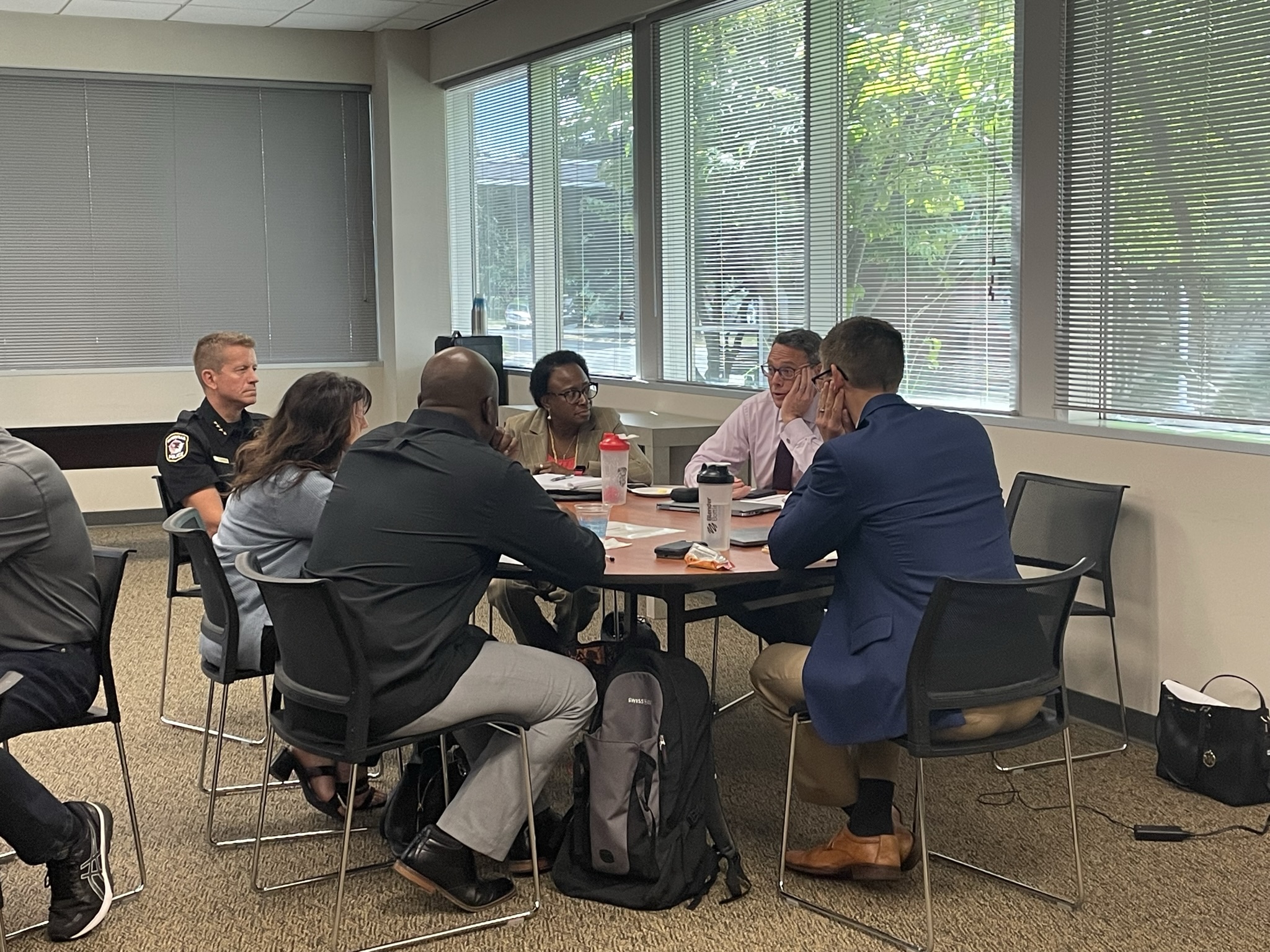
LORE offers a structured learning environment where practitioners work through real organizational challenges alongside peers from other departments and jurisdictions. Participants take part in monthly in-person lectures at the NIU Naperville Campus, where they:
- Learn why organizations resist change and how they adapt;
- Examine how inherited assumptions still shape current practice;
- Apply organizational change concepts to issues they currently face;
- Learn from peers navigating similar constraints; and
- Test new ways of working within existing structures.
In between monthly sessions, participants are provided with resources, readings, and assignments to support their progress on a pilot project unique to their organization. Virtual discussion boards with peers and one-on-one coaching sessions provide the ongoing support needed to apply knowledge gained in the classroom to real-time challenges in the workplace. Uniquely, the LORE program is customized for each cohort to address the specific challenges faced by participants. During the course of the program, participants design a pilot project which is centered around challenges they face in their everyday work. Previous pilot projects developed during the LORE program have included:
- Redesigning onboarding processes to shift from fragmented, department-led practices to a coordinated, organization-wide system.
- Embedding community engagement goals into existing data collection processes.
- Creating a leadership development framework to strengthen internal capacity, culture, and communication beyond technical skill training.
- Examining supervisor and manager training as a lever for embedding continuous improvement practices across small organizational ecosystems.
- Utilizing staff feedback to identify systemic changes to hiring, training, and employee support structures to improve frontline workforce retention.
- Identifying leadership-backed internal processes to institutionalize language access practices across departments.
While each participant works on projects unique to their organization, the emphasis of the course is on building shared language, cross-functional understanding, and enhanced capacity to navigate organizational challenges in real time, whatever they may be. These are assets that participants can rely on long after any single initiative ends.
Who LORE Is Designed For
LORE is particularly valuable for practitioners who:
- Are navigating complex change without clear precedents
- Want stronger tools for navigating complexity and tradeoffs
- Want to strengthen internal leadership capacity to manage external outcomes
- Feel the tension between equity values and institutional realities
- Are managing systems that feel increasingly misaligned with community expectations
Participants do not need any prior training in organizational theory. LORE provides a practical foundation grounded in lived experience.
Adapting Institutions Built for Another Time
LORE starts from a simple but often unspoken reality: public institutions carry history. They also carry responsibility. The task is not to discard those institutions, but to understand them well enough to evolve responsibly so they can meet the demands of the present while honoring their public mission.
For communities grappling with the limits of mid-20th-century systems in a 21st-century context, LORE offers a way to build the internal capacity needed to adapt. Effective leadership today requires understanding how inherited systems work, where they constrain action, and how they can evolve over time. By strengthening the practice of organizational change, with equity as a guiding value, LORE supports city managers in leading institutions built for another era toward a more equitable future.
Interested in Learning More?
Check out LORE or sign up for Office Hours with Dr. Kathleen Yang-Clayton to learn more about LORE and whether it is a good fit for your organization.
Applications for the 2026-2027 LORE program will open in May 2026.